
The historic church
of the Augustine nuns
of the Mercy of Jesus
The Church of the Augustines-de-l’Hôtel-Dieu-de-Québec, built between 1800 and 1803, is a remarkable example of neoclassical religious architecture in Québec. Located at the heart of the Monastère des Augustines, this church, with its Latin cross layout and single nave, provides an intimate atmosphere of reflection and prayer.
A sacred space, it is also the resting place of Blessed Marie-Catherine de Saint-Augustin, a significant figure in Canada’s spiritual history. Her shrine, preserved within this historic church, reflects the magnitude of her spiritual devotion and the depth of her selfless offering—a gift of grace that continues to inspire generations and shape the legacy of the Augustines.
We warmly invite you to visit this exceptional site, where architectural beauty and historical richness come together to offer a unique and inspiring experience.
The church also houses a remarkable art collection, including several masterpieces by European artists sent from France in the late 18th and early 19th centuries, highlighting the enduring influence of European sacred art in Québec. Among these works are:
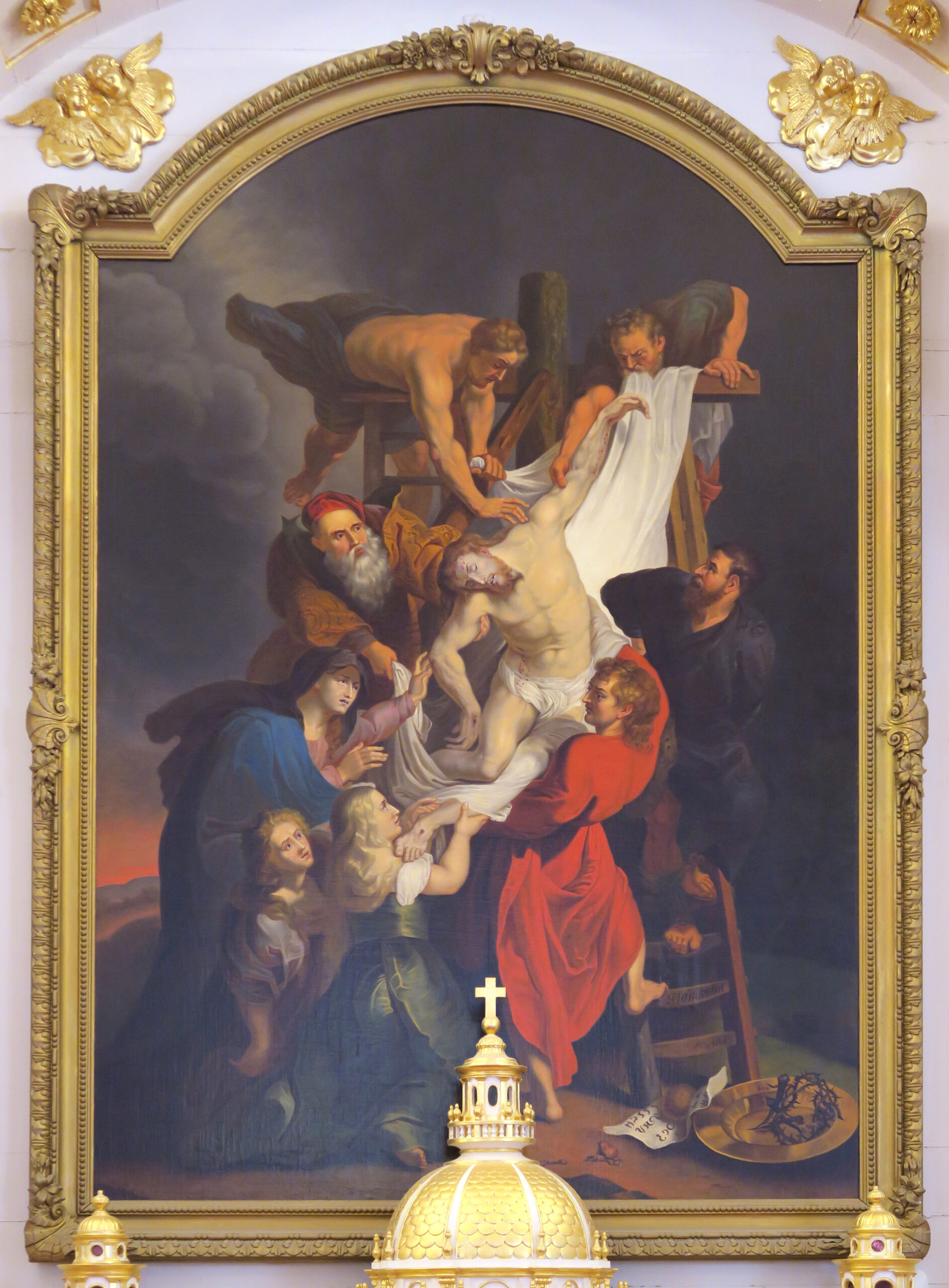
The "Descent from the Cross" by Antoine Plamondon
The large painting above the main altar is a reproduction of The Descent from the Cross by Peter Paul Rubens (1577–1640), created in 1840 by the Quebecois painter Antoine Plamondon (1804–1895).
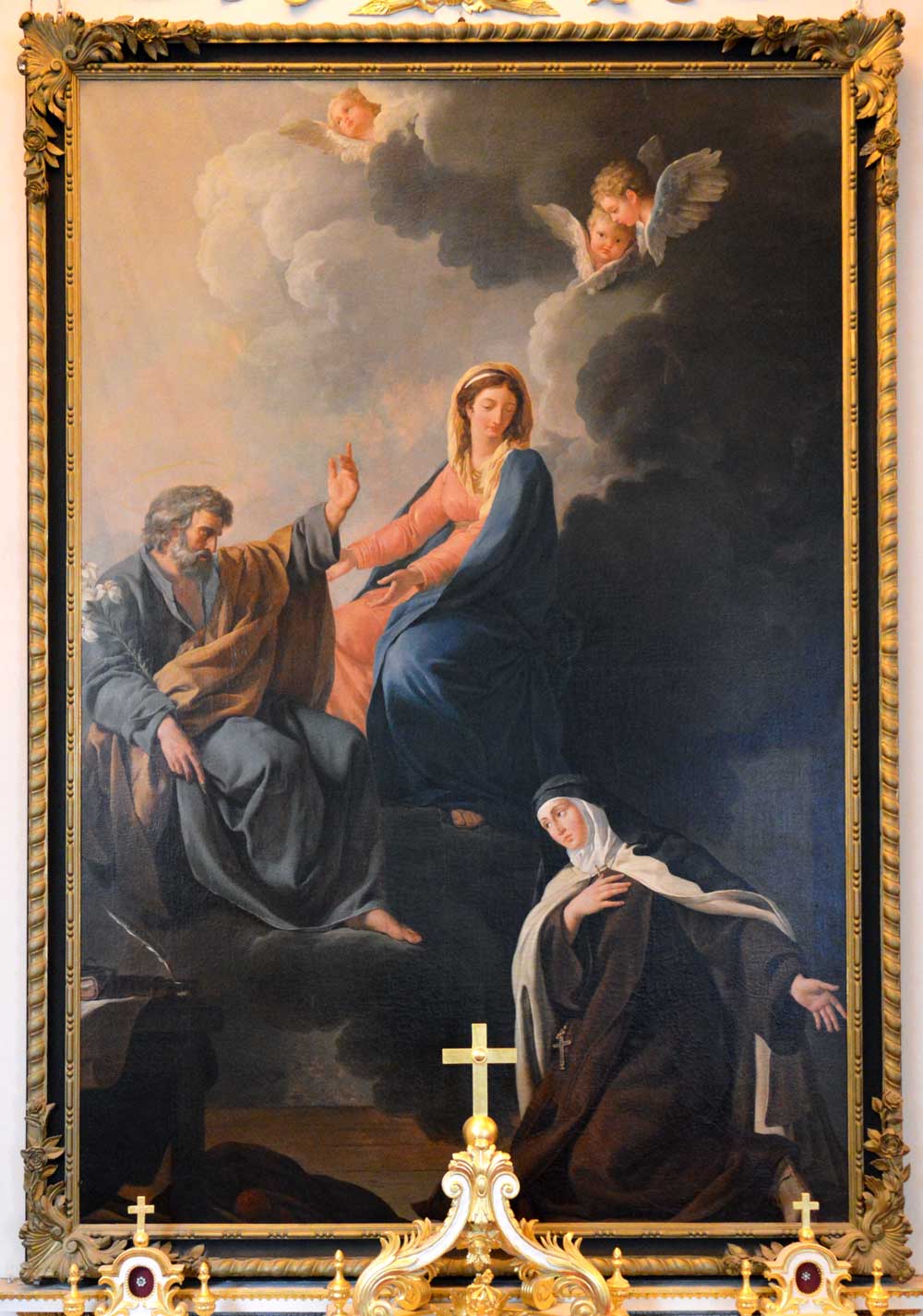
The “Vision of Saint Teresa of Avila”
by François-Guillaume Ménageot
Painting above the left side altar
Painted around 1785 by François-Guillaume Ménageot (1744–1816), this painting is titled Vision of Saint Teresa of Avila. This work is unique in being the only one still on-site, originating from the Desjardins collection. (See additional information below.)
In 1817, the church received religious paintings acquired by Abbé Philippe-Jean-Louis Desjardins (1753–1833) during the bankruptcy of a French banker. These works included pieces confiscated from Parisian churches during the Revolution. He sent them from France to his brother, Abbé Louis-Joseph Desjardins (1766–1848), who was then chaplain to the Augustinian nuns, as his elder brother had been. These masterworks were intended to adorn the churches of the Diocese of Quebec. They were retouched, displayed, and sold in the Augustinians’ church, which still retains one of them, “The Vision of Saint Teresa of Avila” (1787) by François-Guillaume Ménageot (1744–1816). This painting originated from the Carmelite Convent of Saint-Denis near Paris.
(According to: Répertoire du patrimoine culturel du Québec, Ministry of Culture and Communications of Quebec.)
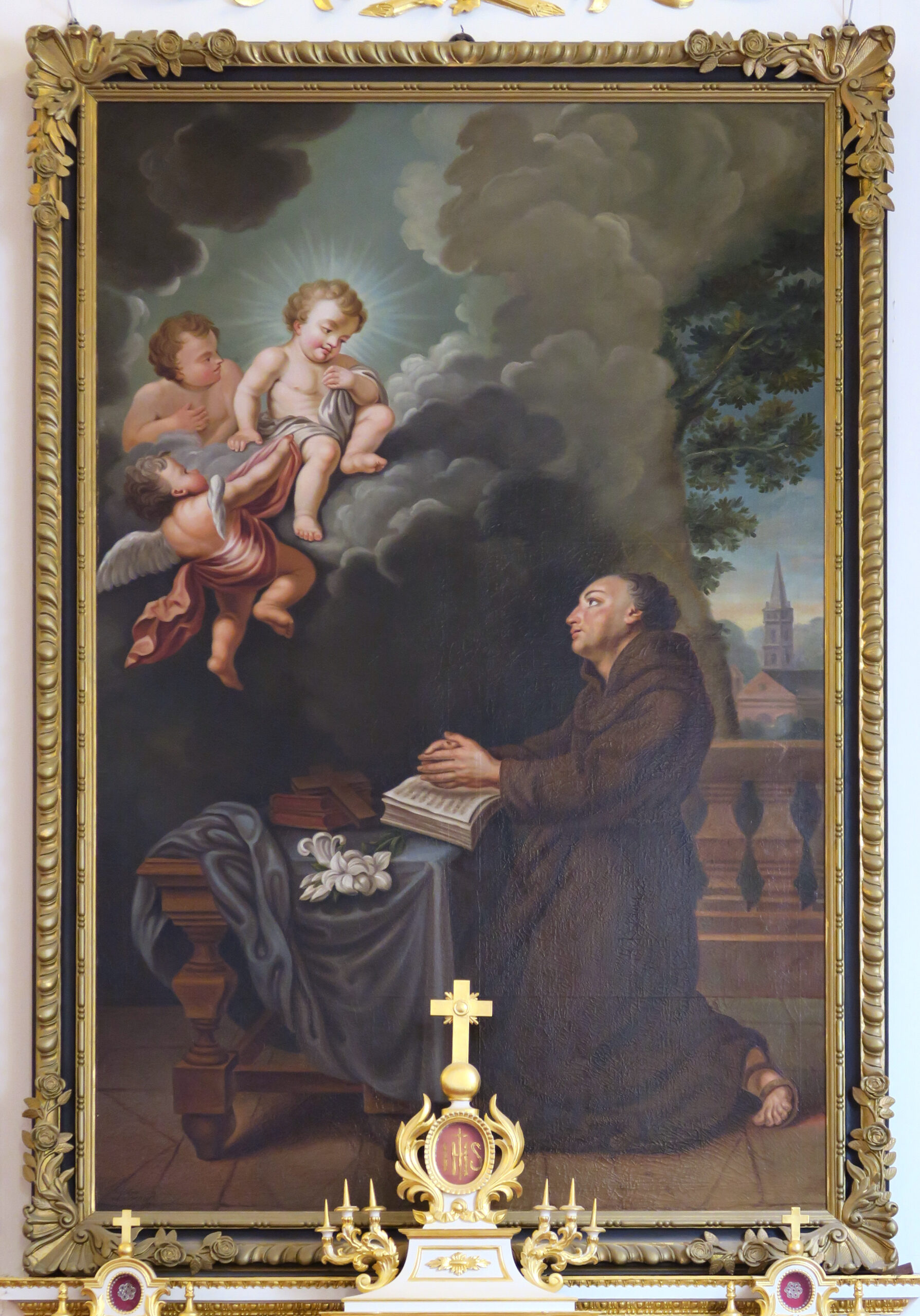
“The Vision of Saint Anthony of Padua”, Unknown Artist
Painting above the right-side altar
The painting titled The Vision of Saint Anthony of Padua is inspired by the work of Ciro Ferri (1634–1689). Painted by an unknown artist before 1803, it was retouched by Louis-Hubert Triaud (1790–1836) between 1829 and 1831.
The painting is believed to have been donated to the Augustinian nuns of the Hôtel-Dieu de Québec in 1803 by Abbé Antoine-Bernardin Robert de la Pommeraie (1757–1826), a priest of the Séminaire de Québec and confessor to the Hôtel-Dieu de Québec from 1796 to 1807. The donation was made as part of a fundraising campaign for the construction of the church. The following year, in 1804, Abbé Robert de la Pommeraie also donated a “Roman-style” altar to the Augustinian nuns for their chapel dedicated to Saint Anthony, as part of the same fundraising campaign. On June 8, 1804, it was decided in a chapter assembly to establish the feast of Saint Anthony in the liturgical calendar of the Augustinian nuns.
(According to: Répertoire du patrimoine culturel du Québec, Ministry of Culture and Communications of Quebec.)
The church of the Hôtel-Dieu de Québec monastery was built between 1800 and 1803, thanks to the generosity of skilled tradesmen and the reuse of materials from demolished buildings, including the Intendant’s Palace. Pierre Émond (1738–1808), a master carpenter and sculptor, oversaw the construction. The façade was modified in 1839 by architect Thomas Baillairgé (1791–1850), giving it its current appearance. The bell tower, which had crowned the monastery since 1756, was placed on the ridge of the sacristy in 1810 and then installed atop the façade in 1931.
At the initiative of Vicar General Jérôme Demers (1774–1853), the Augustinian nuns commissioned Thomas Baillairgé to redesign the church interior. In 1829, he designed plans for a new décor, which included a false vault and the retables of the choir and chapels. Completed in 1832, it is one of the few decors where Baillairgé himself worked as a sculptor. In 1833–1834, Baillairgé also created the tabernacle of the main altar, which rests on a Roman-style tomb made in 1803 by a sculptor from the Écores workshop. The side altars, meanwhile, were crafted between 1845 and 1850 by his student, Raphaël Giroux (1815–1869), based on Baillairgé’s designs.
(According to: Répertoire du patrimoine culturel du Québec, Ministry of Culture and Communications of Quebec.)
The Reliquary of Blessed Marie-Catherine of Saint-Augustin
The precious reliquary of Blessed Marie-Catherine of Saint-Augustin houses her sacred relics, displayed for veneration. This ornate gold reliquary, created in 1717 by Noël Levasseur, features engraved instruments of the Passion on its base and Latin inscriptions honoring her sanctity.
Marie-Catherine of Saint-Augustin, born in Normandy in 1632, left a profound mark on the history of the Augustinian nuns through her mystical life and her dedication as a hospital nun in Québec. Beatified in 1989, her relics continue to inspire faith and devotion.
Description of the Reliquary
The reliquary is adorned with gold leaves and was crafted by artist Noël Levasseur in 1717. The pedestal was created by artist Jules A. Carrier (Le Cagibi) in the 1950s. The reliquary contains the bones of Blessed Mother Marie-Catherine of Saint-Augustin, who passed away in 1668.
(According to: Répertoire du patrimoine culturel du Québec, Ministry of Culture and Communications of Quebec.)
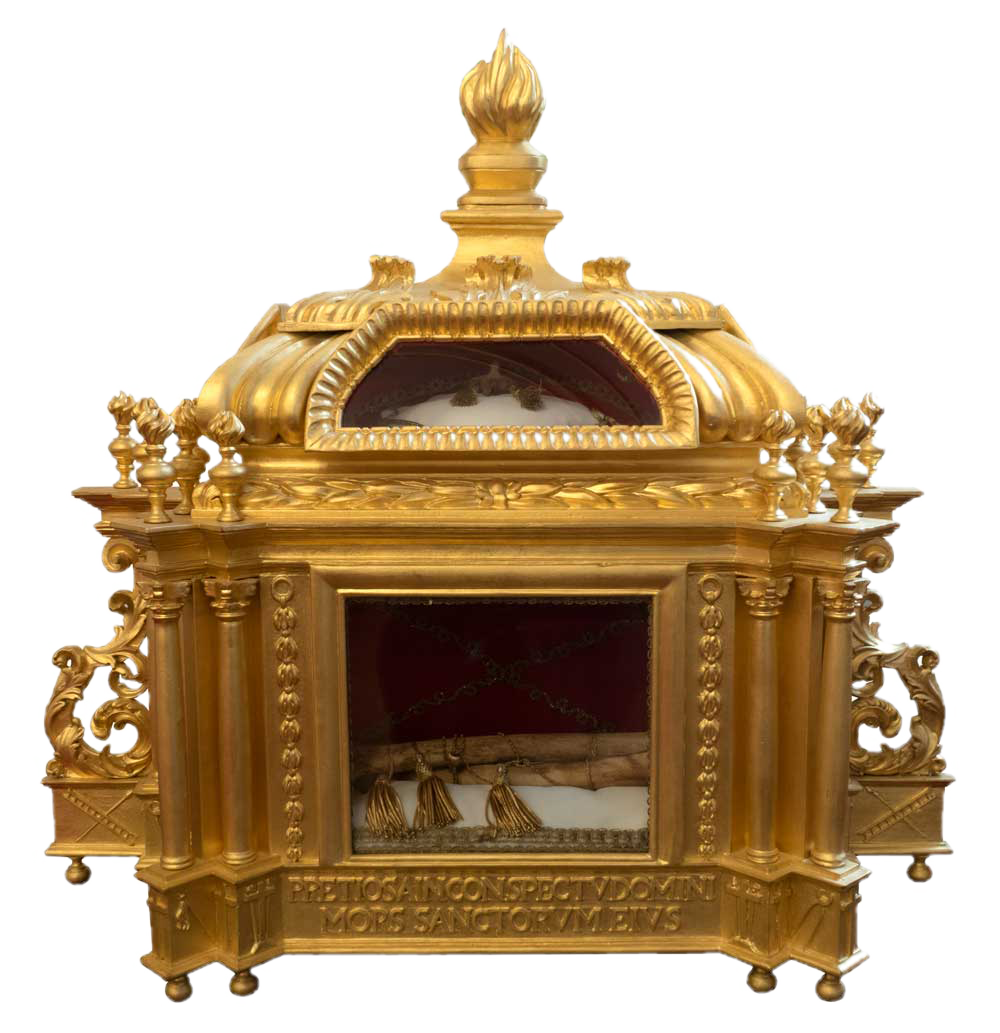
The Reliquary of Mother Catherine of Saint-Augustin
Crafted in 1717 by Pierre-Noël Levasseur, the reliquary of Mother Catherine of Saint-Augustin evokes a blazing flame, symbolizing fervor and passion. At the top of the reliquary, an enflamed heart—added in recent years—represents the burning love in Catherine’s heart. Previously, a cross crowned the reliquary, signifying the Savior’s sacrificial love.
The reliquary’s base is adorned with the instruments of the Passion, underscoring Catherine’s role as an innocent, willing victim who bore great suffering for others. Her sacrifices, made to preserve the nascent colony, are crowned by a laurel wreath atop the reliquary—a symbol of victory. This wreath echoes the Augustinian motto: “Qui coronat te in misericordia” (Who crowns you with mercy - Psalm 102:4).
The current heart draws inspiration from Saint Augustine, often depicted holding a flaming heart, symbolizing the fire of Christ's love. Catherine was consumed by this love, which inspired her to become a nun, a missionary in Canada, and ultimately to offer herself as a victim for the colony's endurance and the Catholic Church’s establishment in Canada.
The reliquary’s base is adorned with the instruments of the Passion, underscoring Catherine’s role as an innocent, willing victim who bore great suffering for others. Her sacrifices, made to preserve the nascent colony, are crowned by a laurel wreath atop the reliquary—a symbol of victory. This wreath echoes the Augustinian motto: “Qui coronat te in misericordia” (Who crowns you with mercy - Psalm 102:4).
Twelve Torches: Placed in groups of three at the reliquary's four corners, these torches represent the twelve apostles and the universality of the Church. Their delicate bases suggest the apostles' humility and lack of worldly power, yet their divine mission endures. Similarly, Catherine, arriving in Canada as a young girl, played a pivotal role in laying the foundations of a Christian nation.
Sur la châsse on peut voir douze flambeaux placés par groupe de trois aux quatre coins supérieurs. Les quatre points cardinaux évoquent la terre entière. Catherine qui fait partie des fondateurs de la portion canadienne de l’Église universelle est entourée par ces douze feux qui nous semblent représenter les douze apôtres. Chacun de ces flambeaux qui ornent le haut de la châsse repose à la base sur un pied très délicat qui donne une impression de fragilité. Il donne à penser que les apôtres n’étaient pas des gens puissants, instruits, riches ou influents. C’est à eux, pourtant, que le Christ a confié son Église appelée à perdurer dans le temps. À Catherine, presqu’encore une enfant, lors de son arrivée en terre canadienne, le Christ assigne une part importante dans l’établissement des fondements d’une nation chrétienne.
Engraved Inscriptions: The reliquary bears the Latin text: “Pretiosa in conspectu Domini mors sanctorum eius” (Precious in the sight of the Lord is the death of his saints - Psalm 116:15). Saint John of the Cross interpreted this as reflecting the saints' profound love for God during their earthly lives.
Maltese Crosses: Flanking the reliquary’s base, these crosses may symbolize Catherine’s affiliation with a hospital order and her spiritual strength as a warrior against evil.
A Legacy of Faith
Catherine’s remarkable life and sacrifice led to her being recognized as a founder of the Church in Canada and a representative of the Augustinian Sisters. Her reliquary, rich in symbolism, continues to inspire the faithful, preserving her memory as a cornerstone of the Christian heritage in Canada.
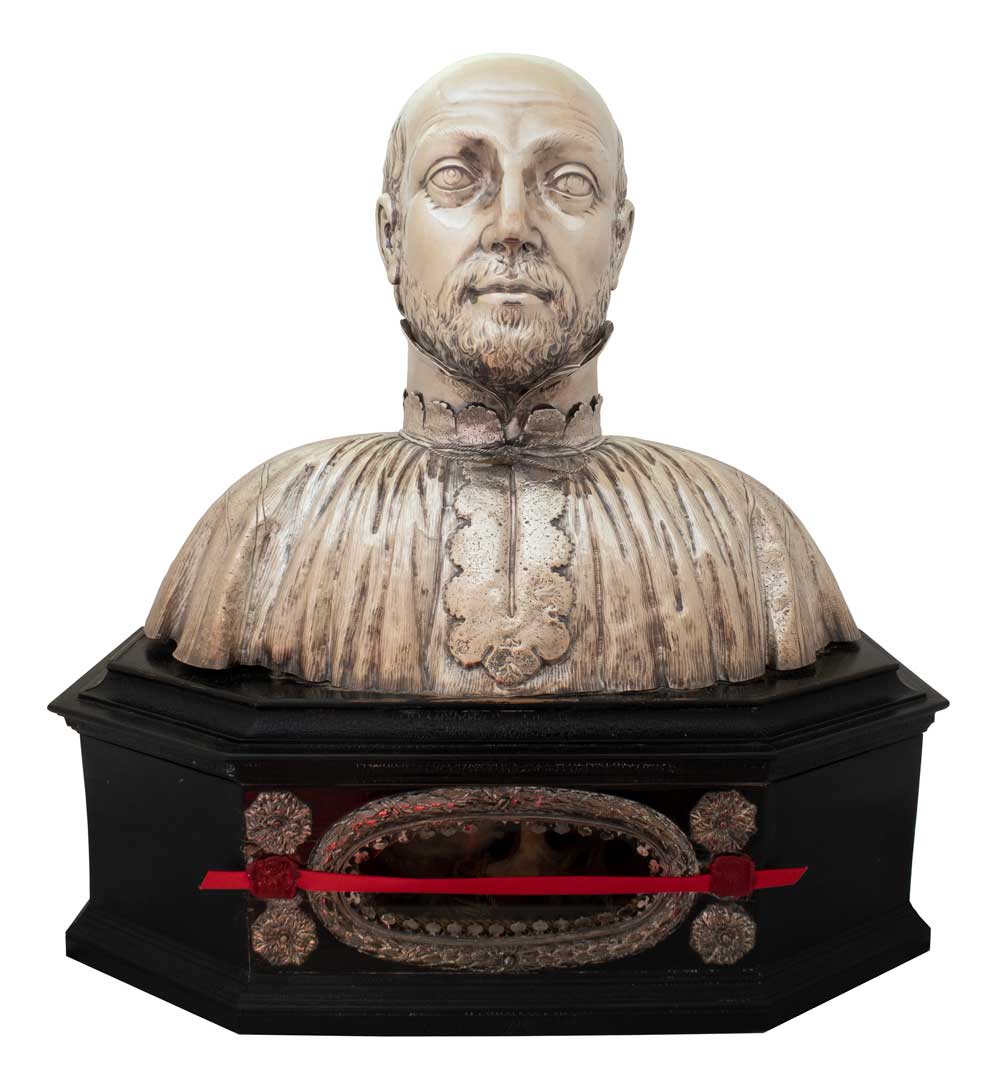
The Reliquary Bust of Saint Jean de Brébeuf
This solid silver bust depicts Saint Jean de Brébeuf, a Jesuit missionary and martyr, and contains a visible relic of his skull.
Crafted in France around 1664 by the goldsmith Charles de Poily, this exquisite reliquary serves as a testament to the spiritual bond between Saint Jean de Brébeuf and Marie-Catherine of Saint-Augustin. Catherine considered Brébeuf her celestial spiritual director, drawing inspiration and guidance from his martyrdom and unwavering faith.
The bust not only honors Brébeuf's sacrifice but also symbolizes the deep connection between two pivotal figures in the spiritual and missionary history of New France.
Excerpt from: Latourelle, René. “First Mystic of New France”
in Jean de Brébeuf. Montreal: Bellarmin, 1993. pp. 270–274.
Three witnesses to Brébeuf’s mystical life.
- Father Ragueneau,
- Marie de l’Incarnation
- Catherine de Saint-Augustin.
The principal witness to this life is undoubtedly Father Ragueneau, who affirms that he “knew him very intimately, as much as one could know a man of the world” (JR 34:192, cited from Thwaites, R.G., ed. The Jesuit Relations and Allied Documents, 73 vols., Cleveland, 1896–1901). He writes that Brébeuf’s life was “full of lights, which were immense in the ways of holiness and of God’s extraordinary favors upon him” (JR 34:190). He adds: “What appeared on the outside was nothing compared to the treasures of grace with which God enriched him daily and the favors He granted him” (JR 34:160). In Chapter VII of the life of Catherine de Saint-Augustin, Ragueneau is even more explicit: “He was always united with God, who favored him,” he says, “with a very sublime gift of prayer and many gratuitous graces admired in great saints.” And, “despite this ease in conversing with God,” he says, “he prepared for prayer as meticulously as a novice at the very beginning of their spiritual journey” (JR 34:172).
God’s action in Brébeuf’s life was accompanied by extraordinary phenomena, such as ecstasy and rapture. “At times,” writes Ragueneau, who merely transcribed Brébeuf’s journal, “I find that God, in prayer, detached him from all his senses and united him to Himself with vehement surges of love […] at other times, he says his entire heart was carried to God in ecstatic surges of love” (JR 34:172). Brébeuf spoke to no one about these favors. “He kept these favors so secret and hidden, except from those to whom he could not, in good conscience, conceal anything, that he never spoke of them, nor gave the slightest hint to anyone. And the conclusion he drew each time was to humble himself further, to mistrust himself, to consider himself the least in the house, and to fear that the devil might deceive him. Finally, he never guided himself by these visions […] but relied solely on the principles of faith, the movements of obedience, and the lights of reason” (JR 34:174–176).
The principles of faith, obedience, and the lights of reason were the criteria Brébeuf employed to test the authenticity of his experiences. Practiced in the discernment of spirits following the method of St. Ignatius, Brébeuf quickly recognized authentic graces from the dazzling but dubious fruits presented by the prince of darkness. Constantly, in his writings, as in most mystics, expressions recur such as: “I thought I saw,” “it seemed to me I saw,” “I thought I heard.” He paid attention first to the spiritual fruit of his visions: a renewal in humility and inner peace. Above all, he let himself be guided by obedience: “I can say,” Ragueneau affirms, “that this virtue was perfect in him: seeing only God in the person of his superior. He revealed his heart with a childlike simplicity, fully docile to the responses given to him, acquiescing without resistance to everything he was told, even when contrary to his natural inclinations, not only outwardly in the eyes of men, but deep within his heart, where he knew that God sought true obedience. He used to say that he was suited only for obedience” (JR 34:176).
A second witness to the depth of Brébeuf’s spiritual life is Marie de l’Incarnation. In a frequently cited text, she states that “the spirit of the sacred Incarnate Word” was given sublimely “to our martyrs,” especially to Father Brébeuf. In expressing this, Marie de l’Incarnation does not claim to equate Brébeuf’s spiritual journey with her own. She merely intends to convey that Brébeuf and his companions demonstrated a zeal and attachment to Christ that reveal a peak of holiness. Drawing from her own experience, she describes an experience analogous to hers. Brébeuf’s mystical experience, however, was distinctively his own, more centered than Marie de l’Incarnation’s on love for the Crucified and a vocation to martyrdom. Instead of focusing on the Incarnate Word, Brébeuf speaks of “Jesus Christ crucified” and “Jesus Christ nailed to the cross.” On this point, however, Marie de l’Incarnation and Brébeuf converge: both pronounced the vow of the most perfect, where for all mystics, union with God becomes a total gift of love to Infinite Love.
Finally, we invoke a third witness of a very particular kind: Catherine de Saint-Augustin. We know from Catherine herself and from her biographer, Father Ragueneau, that Brébeuf, for many years, was in a sense her heavenly spiritual director, guiding her in the ways of the highest prayer, assisting her in her battles against hell, and strengthening her in her role as a willing victim. It was in 1658, during her annual retreat, that Catherine de Saint-Augustin received from God her vocation to suffering, in the example of Rose of Lima, Marguerite-Marie, and Catherine of Siena. She was chosen by God to atone for the sins of New France. For nearly eight years, she endured the worst diabolical temptations. This state of extraordinary suffering called for no less extraordinary help. It was first to help her overcome these assaults of hell that Brébeuf’s assistance was given. To understand how deep the intimacy of these two souls was, one need only hear Catherine de Saint-Augustin speak of one of Brébeuf’s early interventions in her life. She writes: “I always felt Father Brébeuf, but in such an intimate way that it seemed to me I could neither say, think, nor do anything except depending on his will.” As her infernal vexations increased, her heavenly communications with Brébeuf became more frequent. Gradually, he led her to embrace her vocation as a victim for the grave crimes afflicting New France at the time. Her inner pains became true agonies. The forces of hell surrounded her, whispering impious words. She was tempted by hatred, blasphemy, despair, and vengeance. In her crises, Brébeuf reassured her, had her pray, and suggested to her word for word what she should say during Mass and in prayer. Following Brébeuf’s example, she pronounced the vow of the most perfect.
Considering Brébeuf’s personal notes and other writings, and the testimonies of Ragueneau, Marie de l’Incarnation, and Catherine de Saint-Augustin, we are justified in maintaining the judgment formulated at the beginning of the chapter: Brébeuf is the first mystic of New France. He, Marie de l’Incarnation, and Catherine de Saint-Augustin pronounced the vow of the most perfect. The mystical experience of each, however, represents a specific model: apostolic mysticism in Brébeuf; contemplative mysticism in Marie de l’Incarnation; reparative mysticism in Catherine de Saint-Augustin.
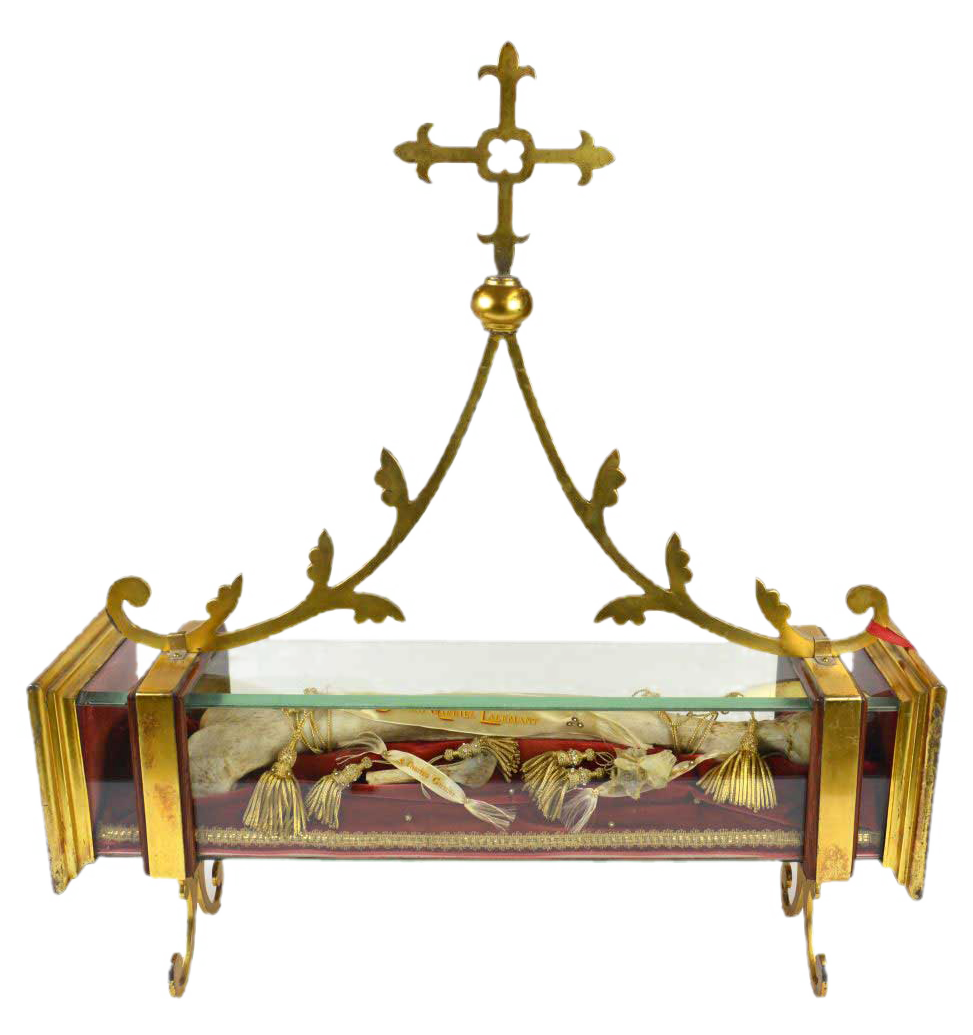
The Reliquary of Saint Gabriel Lalemant and Saint Charles Garnier
This ossuary houses the relics of the Jesuit saints Gabriel Lalemant and Charles Garnier, martyrs of New France. Encased in a frame adorned with red velvet and golden accents, these relics serve as a source of devotion and remembrance, honoring the ultimate sacrifice of these missionaries for their faith.
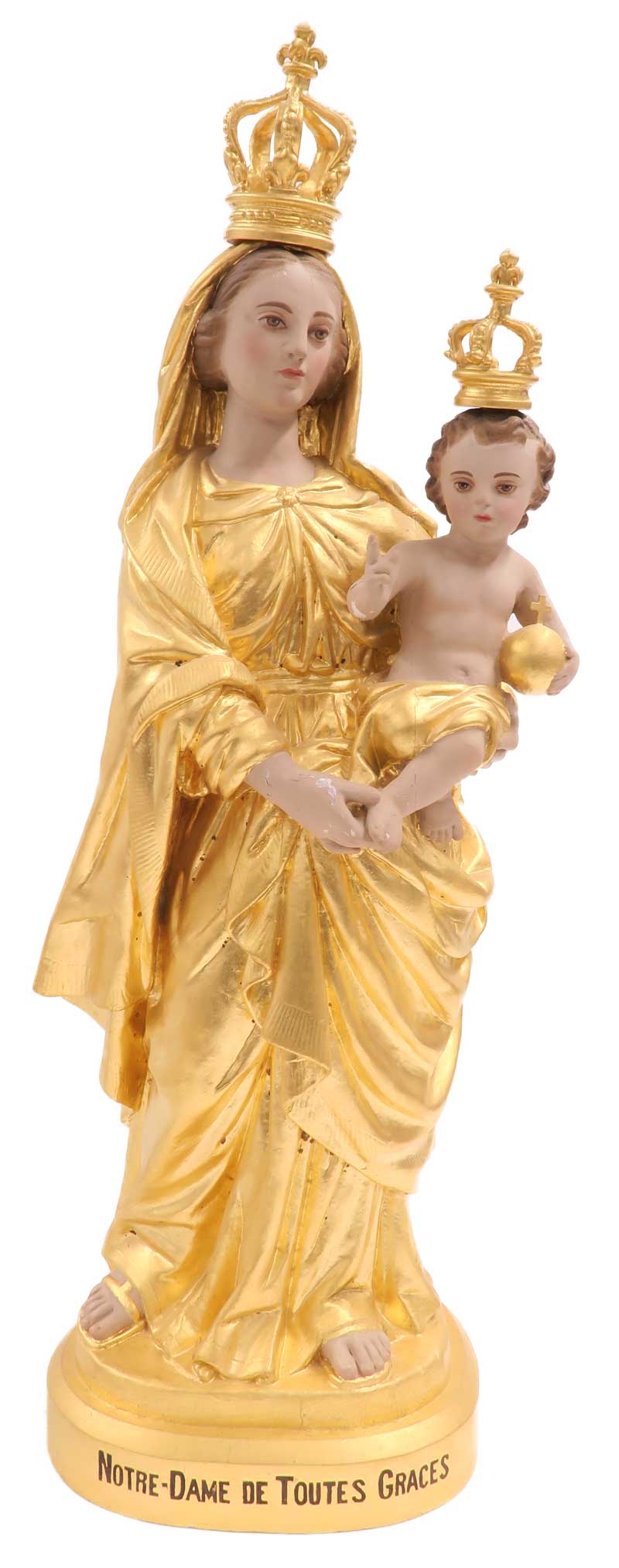
The Statue of Our Lady of All Graces
This statue depicts the Virgin Mary holding the Child Jesus. It was a gift to the Augustinian Sisters of the Hôtel-Dieu of Québec in 1738 from a French sailor, grateful for being saved at sea. Crafted in France, the statue features the Virgin and the Child both crowned.
Rescapée de l’incendie de 1755, la statue a été restaurée par les artistes québécois Antoine Plamondon et Joseph Légaré et occupe désormais une place d’honneur sur l’autel latéral de l’église dédié à la Sainte Vierge.
The Story Behind the Devotion
In the late 17th century, during the autumn season, a ship with a crew of thirty set sail from Québec to France. The journey down the Saint Lawrence River was smooth, but upon reaching the waters near Newfoundland, the ship encountered a violent storm. Despite the tireless efforts of the crew, the vessel was adrift for days, carried over 500 leagues by the relentless winds.
The sailors were eventually driven to the rocky shores of Plymouth, England, where the ship was on the brink of disaster. Facing imminent death, the captain and crew gathered on deck. With little hope left, they turned to prayer, invoking the Virgin Mary to intercede for their safety. They made a vow: if spared, they would travel together to the sanctuary of Our Lady of Grace near Le Havre to give thanks, have a Mass sung, and receive Holy Communion.
The sailors were eventually driven to the rocky shores of Plymouth, England, where the ship was on the brink of disaster. Facing imminent death, the captain and crew gathered on deck. With little hope left, they turned to prayer, invoking the Virgin Mary to intercede for their safety.
The sailors were eventually driven to the rocky shores of Plymouth, England, where the ship was on the brink of disaster. Facing imminent death, the captain and crew gathered on deck. With little hope left, they turned to prayer, invoking the Virgin Mary to intercede for their safety. They made a vow: if spared, they would travel together to the sanctuary of Our Lady of Grace near Le Havre to give thanks, have a Mass sung, and receive Holy Communion.
Miraculously, the winds shifted, pushing the ship away from danger and into safety. True to their promise, the crew visited the sanctuary upon reaching Le Havre and fulfilled their vow with heartfelt devotion.
The Birth of Our Lady of All Graces in Québec
One of the youngest crew members was deeply moved by the Virgin Mary's intercession. He resolved to express his gratitude by spreading her veneration in Canada under the title of "Our Lady of All Graces."
He chose the church of the Hôtel-Dieu of Québec as the home for a statue dedicated to this devotion.
In 1737, this sailor, who wished to remain anonymous, arranged for a friend to contact the Hôtel-Dieu community to inquire whether they would accept such a statue. The Superior of the community welcomed the offer, replying that as the Virgin Mary was the Mother and perpetual Superior of their house, they would gladly honor her with this statue.
On September 12, 1738, the statue of Our Lady of All Graces arrived at the Hôtel-Dieu Monastery in Québec, where it has been venerated ever since. In 1957, this statue was named the Patroness of the Canadian Federation.
Legacy of the Statue
For nearly 250 years, the statue has stood as a testament to faith, gratitude, and the enduring protection of the Virgin Mary. Rescued from the 1755 fire and restored by renowned Québec artists Antoine Plamondon and Joseph Légaré, the statue remains a treasured symbol of devotion, continuing to inspire all who visit.
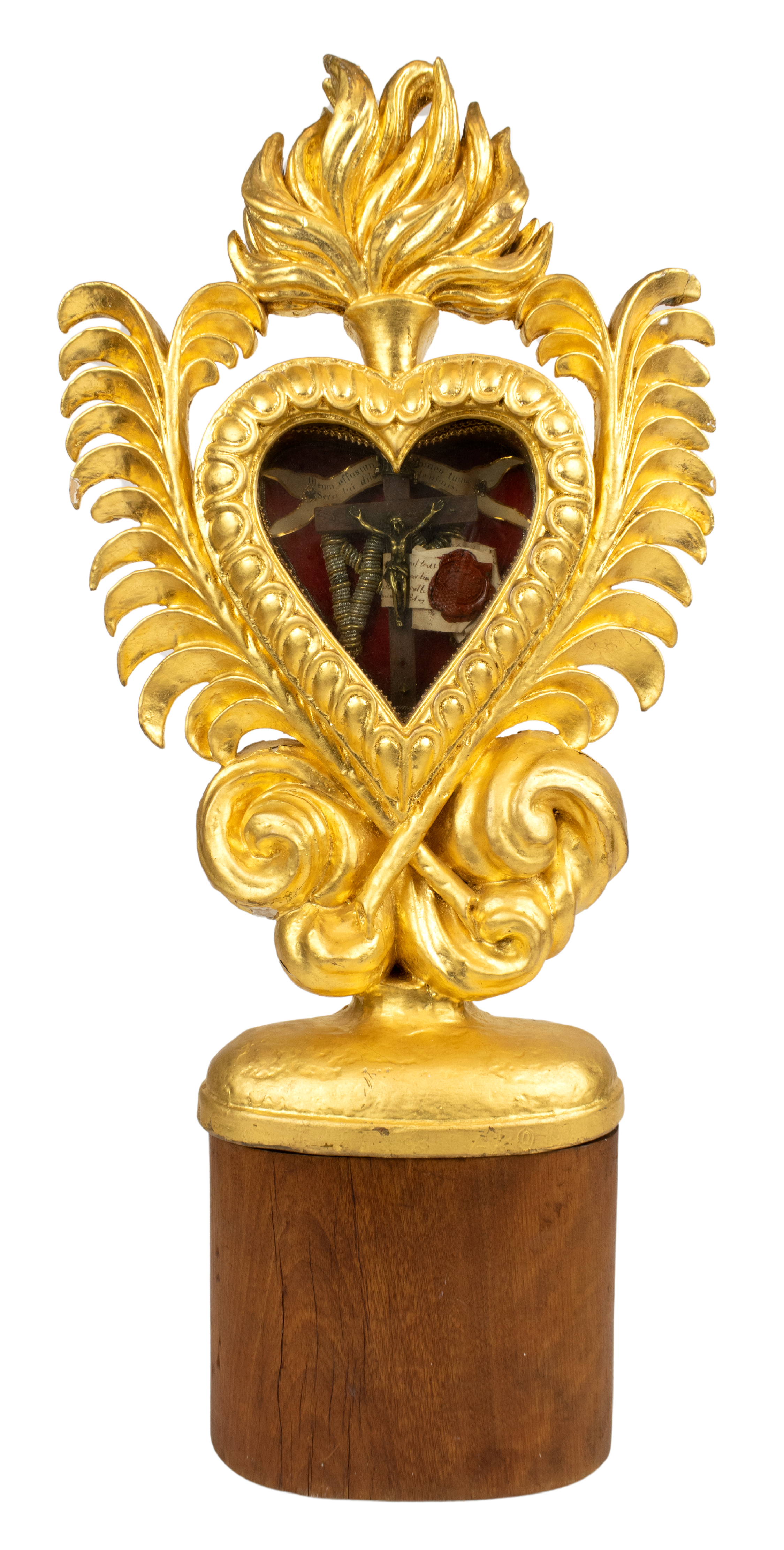
The Outraged Crucifix
This unique crucifix, preserved in a heart-shaped case, is linked to a fascinating story of divinatory practices in the 18th century. It reflects the challenges and superstitions of the time, while remaining a symbol of the deep faith of the Augustines and their spiritual commitment. It was entrusted to the community by Mgr de Pontbriand in 1744.
The Outraged Crucifix
On the morning of October 5, 1742, a considerable crowd gathered in the public square of Montreal, in front of the parish church, to witness a punishment whose unusual circumstances recalled medieval legislation.
A soldier from the Montreal garrison, named Havard de Beaufort, led by the executioner, was kneeling, dressed only in a shirt, his head covered, with a rope around his neck, in front of the main door of the church. He held a two-pound wax torch in his hand and wore a placard on his back and chest with the words: "Profaner of holy things." The sentence against him condemned him to make public amends to God, the king, and justice in this posture and at this location, and to declare, in a loud and intelligible voice, that he had rashly and wickedly outraged the sacred image of Jesus Christ and profaned the words of the Holy Scripture by using them for predictions and divinations.
After enduring this humiliation, he was to be dragged through every street corner of the city to be flogged by the executioner, and then returned to prison, awaiting the departure of ships that would take him to France, where he would serve three years of hard labor.
The crime for which this wretched sacrilege was being punished had been committed in the house of a man named Charles Robidoux in Montreal. The condemned man had taken a crucifix, anointed its ends with a substance believed to be magical, and then exposed them to flames while reciting words from the Holy Scriptures to perform predictions and sorceries.
The news of this desecration quickly spread and sparked public outrage. Bishop de Pontbriand promptly expressed his deep sorrow by issuing a mandate to the clergy and the faithful of Montreal, inviting them to repair the offense committed against the image of the Crucified Jesus through penance and public prayers. He ordered a solemn procession from the parish church to the chapel of Notre-Dame de Bon-Secours, where a public penance would take place, followed by the veneration of the cross.
The bishop then addressed the magistrates to obtain the outraged crucifix, with the intention of displaying it for public veneration in one of the churches of his episcopal city. He chose the Hospitalier’s’ church and sent them the following mandate on March 2nd, 1744:
"To our very dear daughters in Our Lord, the Religious Hospitallers of Quebec.
Last year, you, our very dear daughters, shared in the deep sorrow we felt due to the scandal in Montreal. You are aware of the mandate we issued to repair the desecration of the august and sacred image of Our Lord on the cross. We asked the magistrates for the desecrated crucifix, so that we could display it in a special way for the veneration of true Christians. They zealously complied with our request. We believe it is fitting to choose a particular place to entrust this precious deposit, even more sacred because it was so shamefully desecrated. As you are dedicated by your state to assisting the suffering members of the body of Jesus Christ, an activity to which you devote yourselves with fervor, we believe you will be even more zealous in repairing the insult to the person of Jesus Christ, in His image. It was exposed to the flames: may your hearts, inflamed with His divine love, make amends for this insult. It was intended for crude superstitions, but use it as a shield to protect yourselves from the attacks of the seducing spirit. Perhaps the heavens, favorable to your wishes, will work wonders for those who will adore Jesus Christ represented on this cross in spirit and in truth.
We know that, at the time of the desecration, you, deeply sorrowful, performed a public penance and made a general communion. Confident that your dispositions have not changed, we entrust this adorable cross to you, as faithful spouses, and order you to place it in your church, choosing a day each week to offer adoration and join a general communion.
This mandate is to be read at an extraordinary chapter, transcribed into your registers, and returned to us by Mr. Abbé Briand, canon of our cathedral, to whom we have entrusted the crucifix along with this mandate."
(Archives of the Hôtel-Dieu de Quebec)
With the permission of the superiors.
Note:
Over time, the community of the Augustines of the Hôtel-Dieu de Quebec chose the first Friday of October for the veneration of the outraged crucifix. Until 2019, the crucifix was displayed annually in the choir for veneration. Since 2020, the veneration has been held privately in the small chapel of the Saint-Augustin wing of the community.
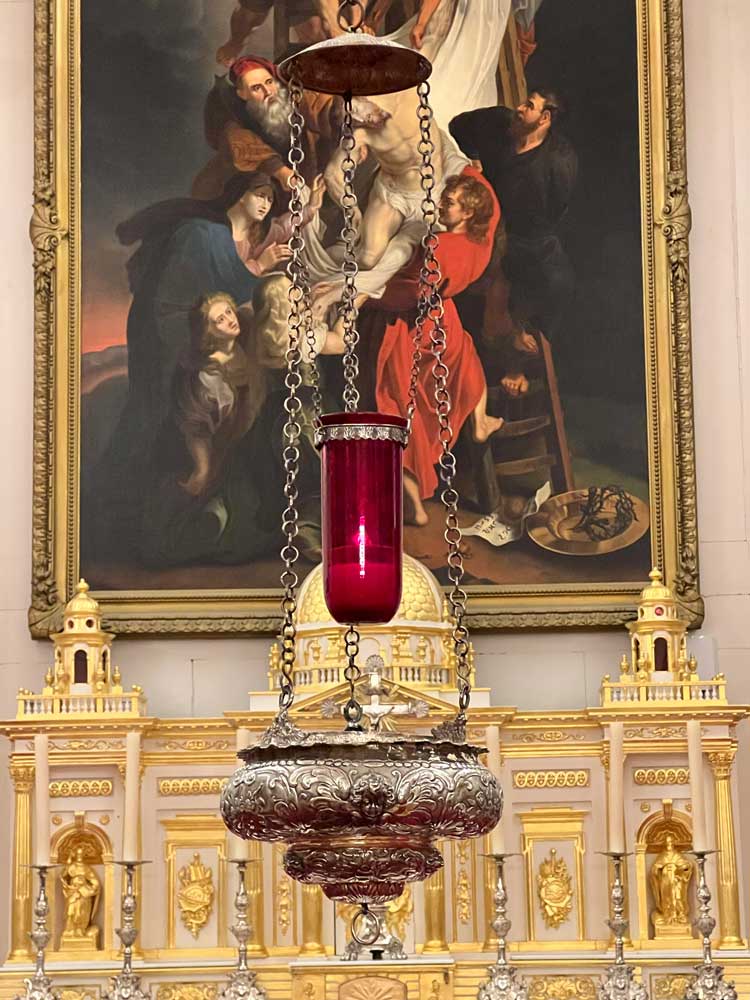
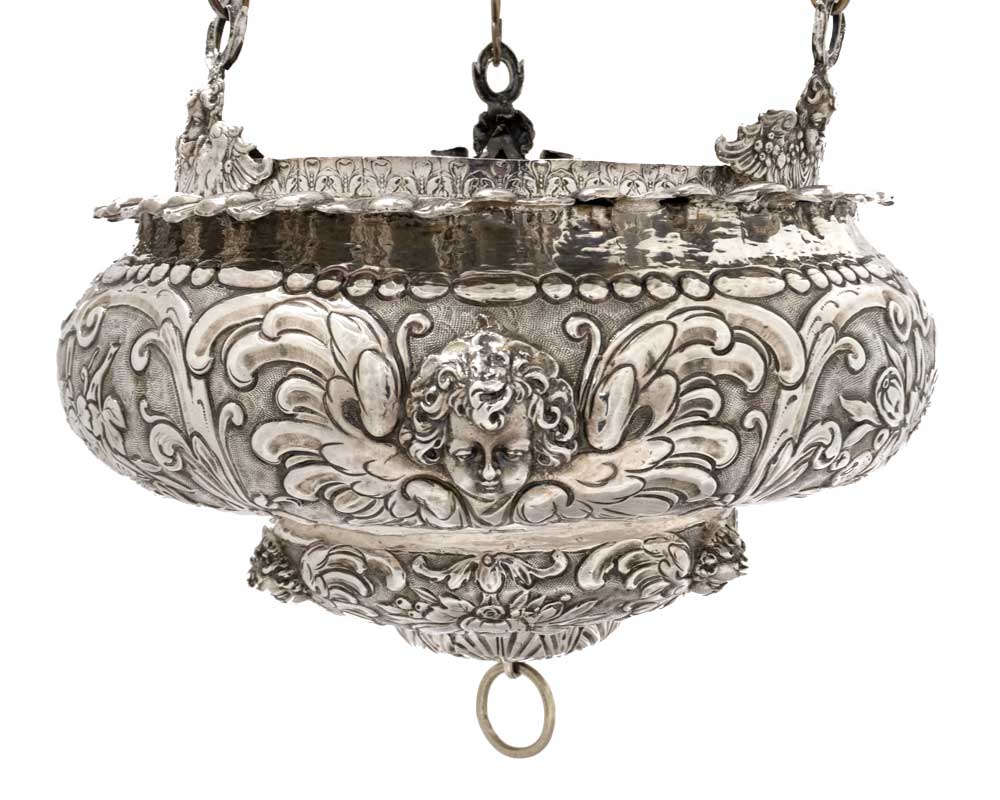
Sanctuary Lamp
Boursier, Claude. 17th century, Silversmith, Paris.
Sanctuary lamp in silver. 1668-1669.
Gift of Daniel de Rémy de Courcelles, 8th Governor of New France from 1665 to 1672. The coat of arms of the Courcelles family is engraved on the sanctuary lamp.
Apostles and Evangelists
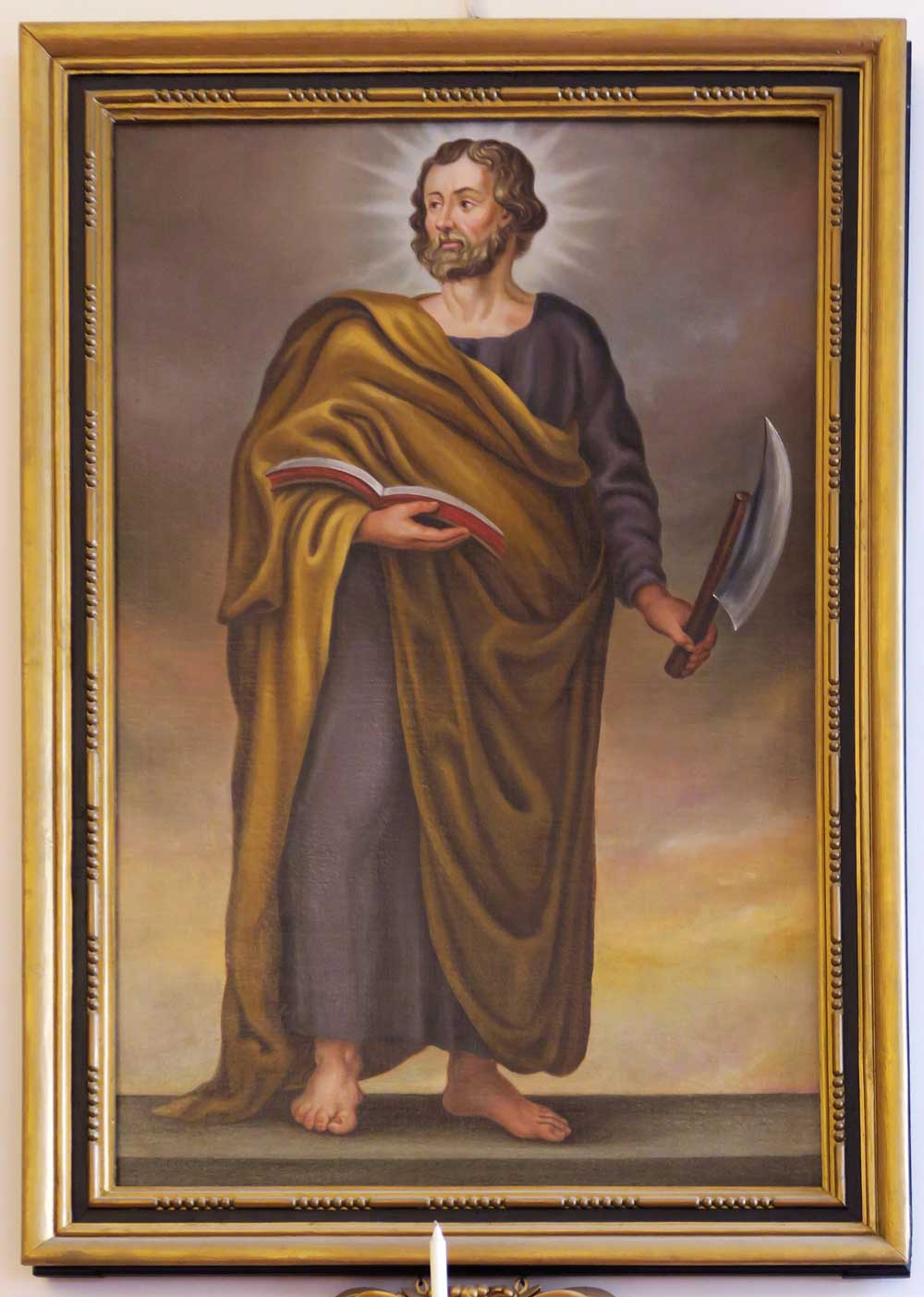
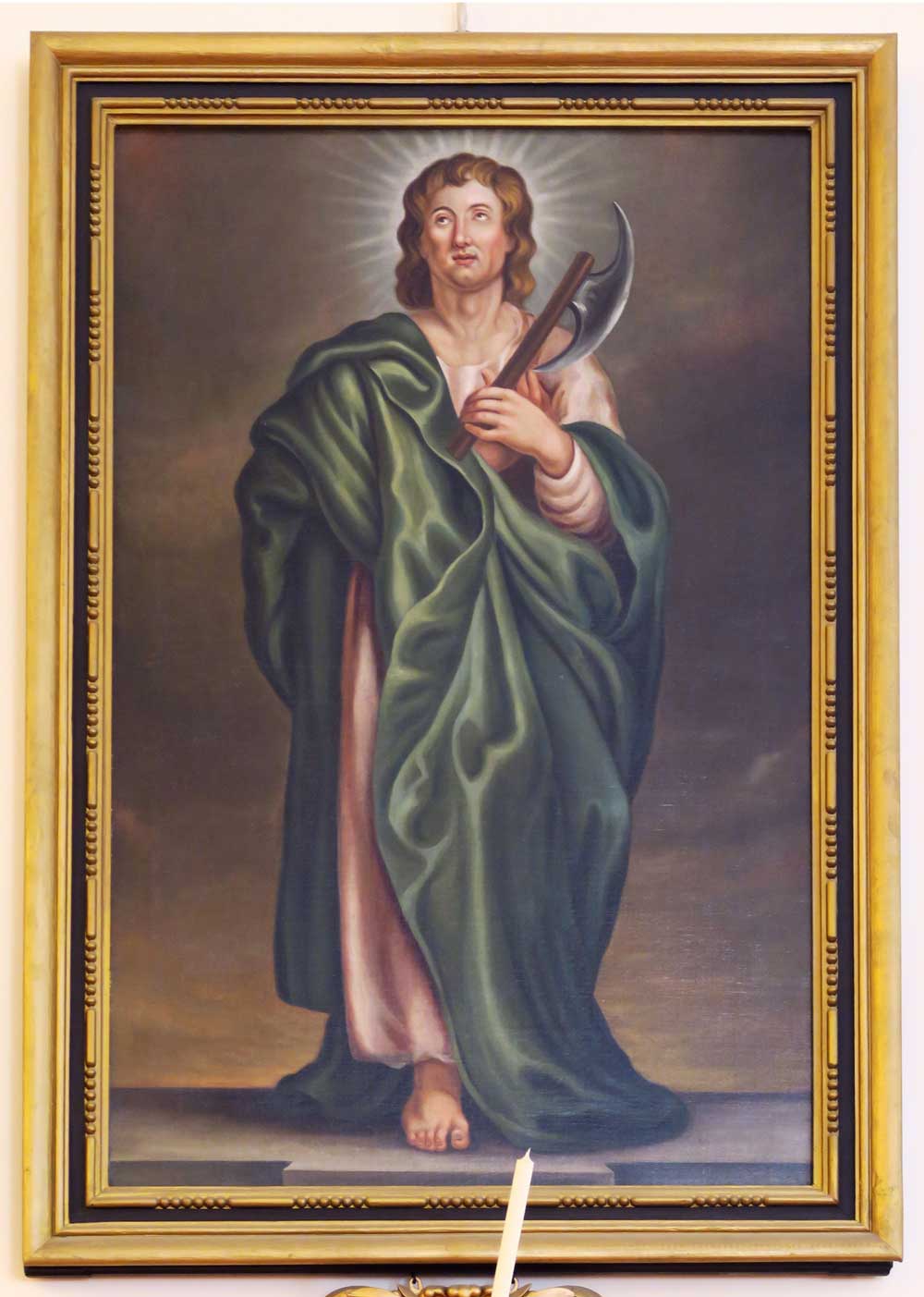
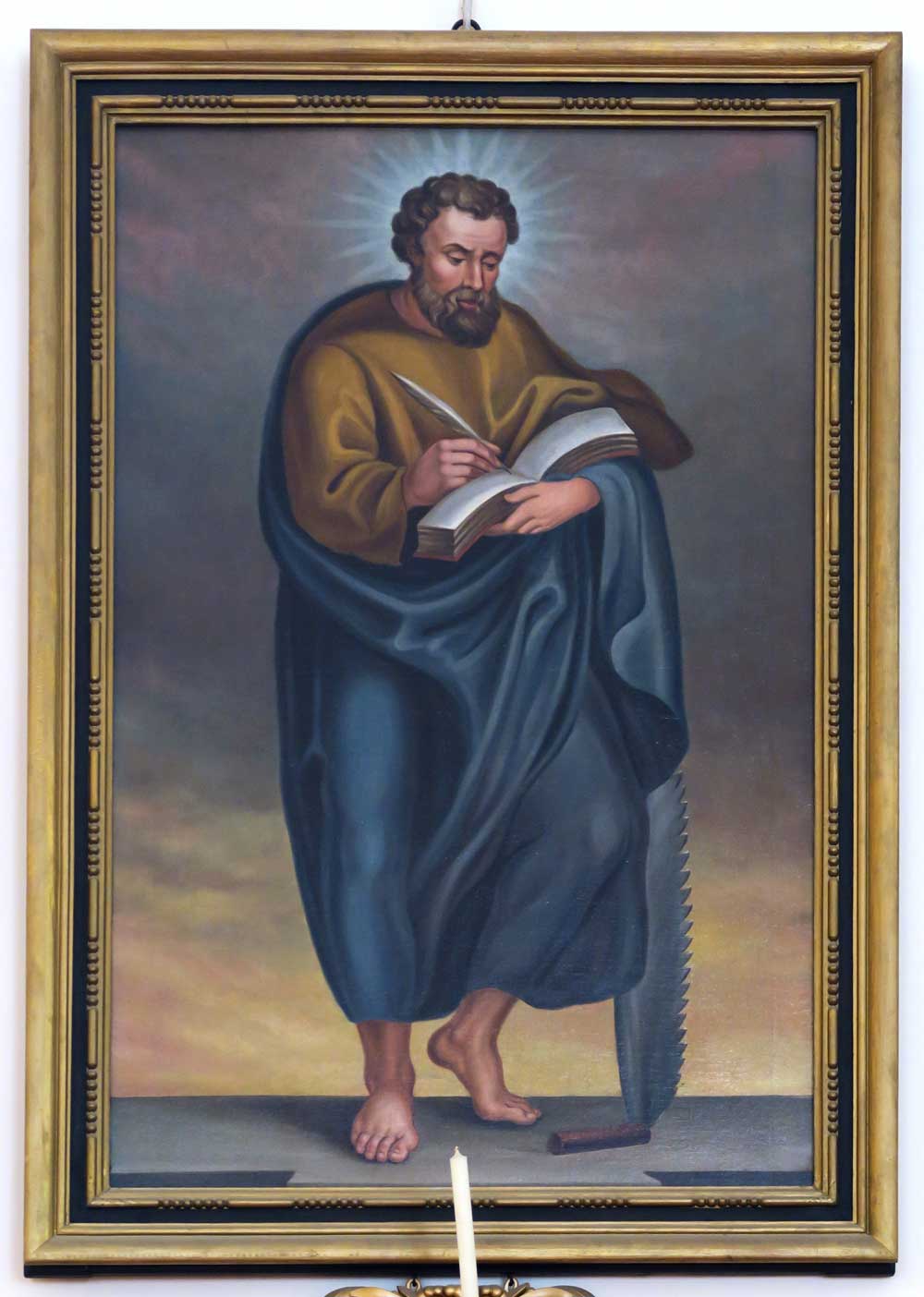
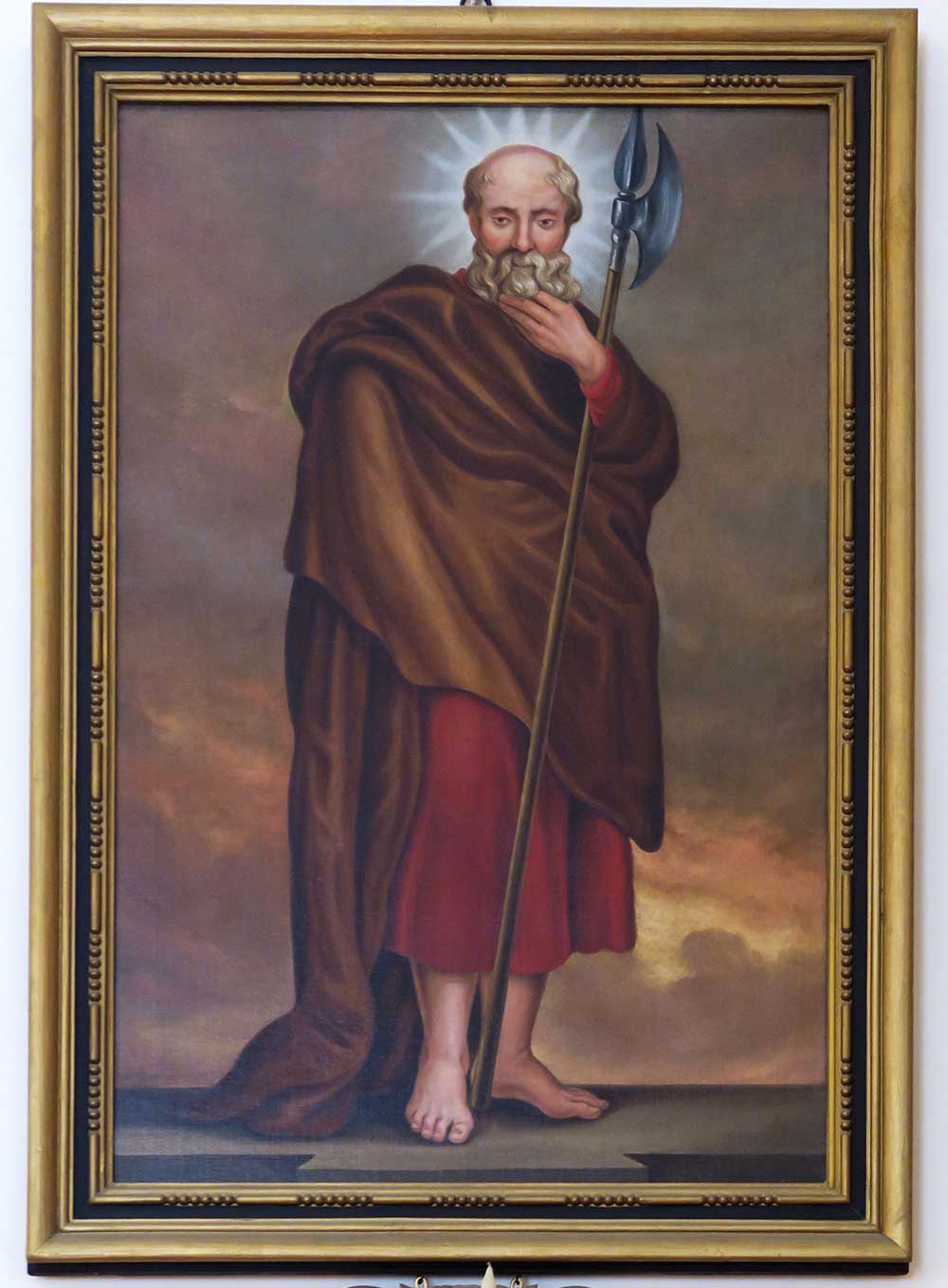
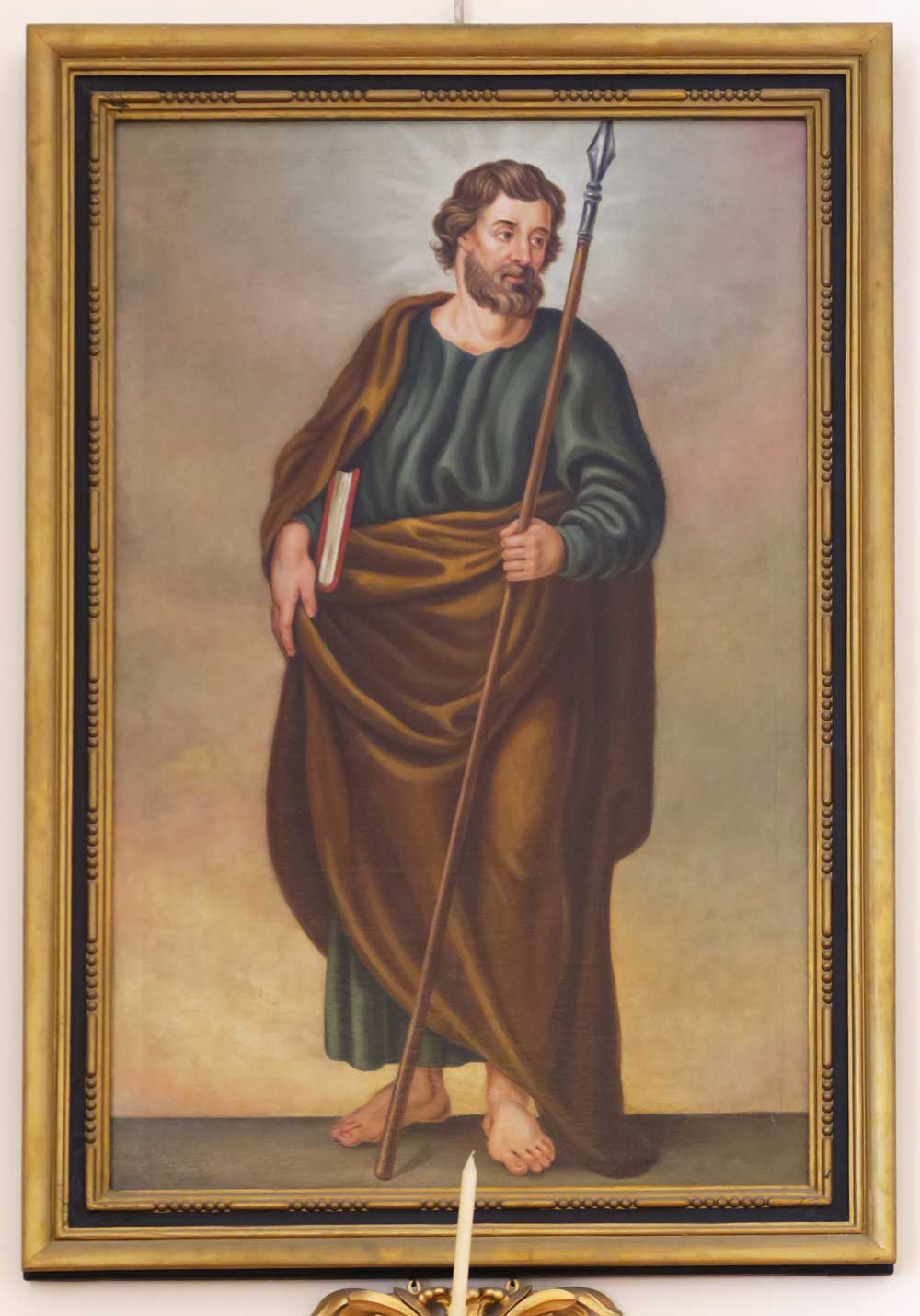
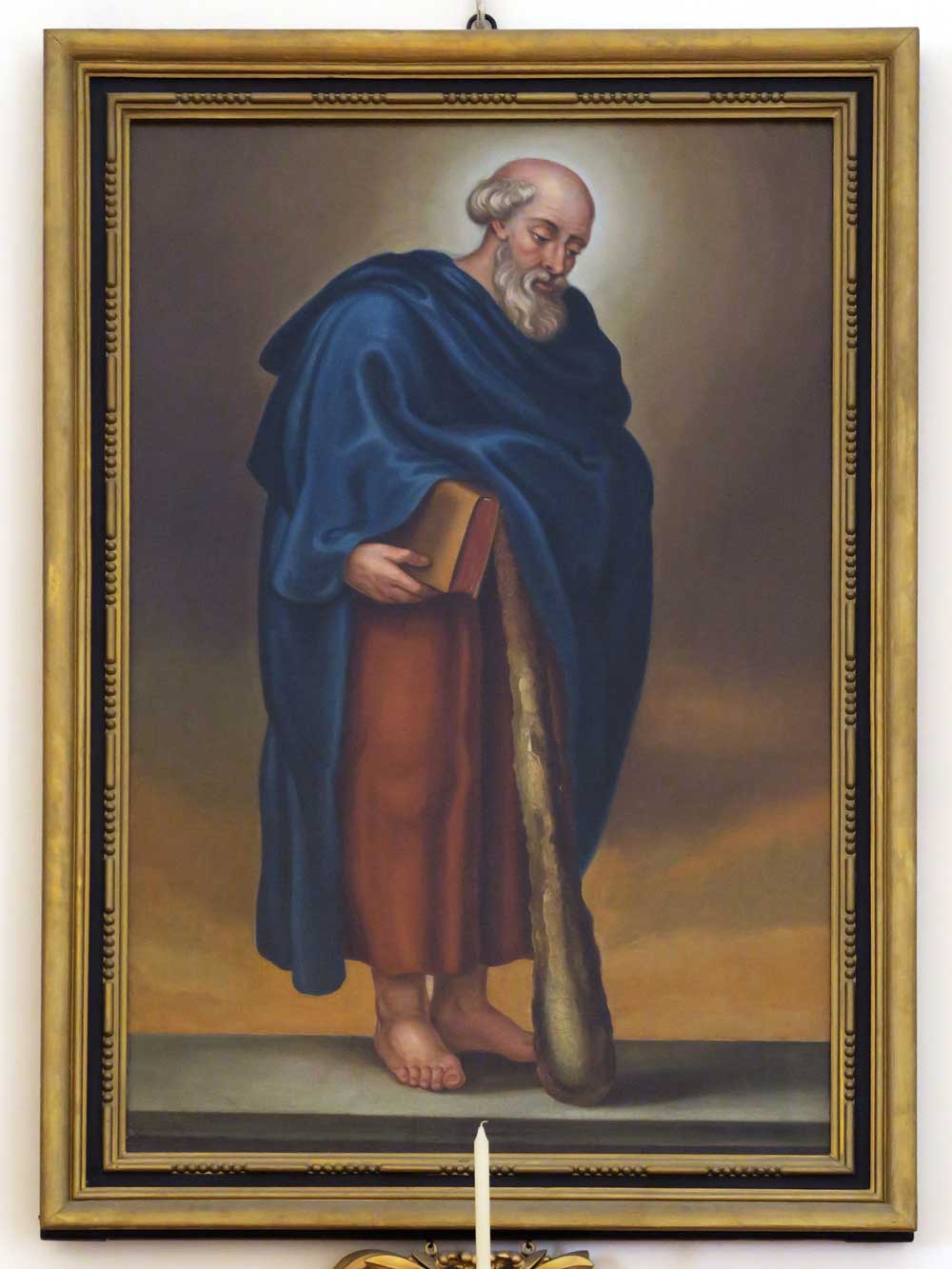
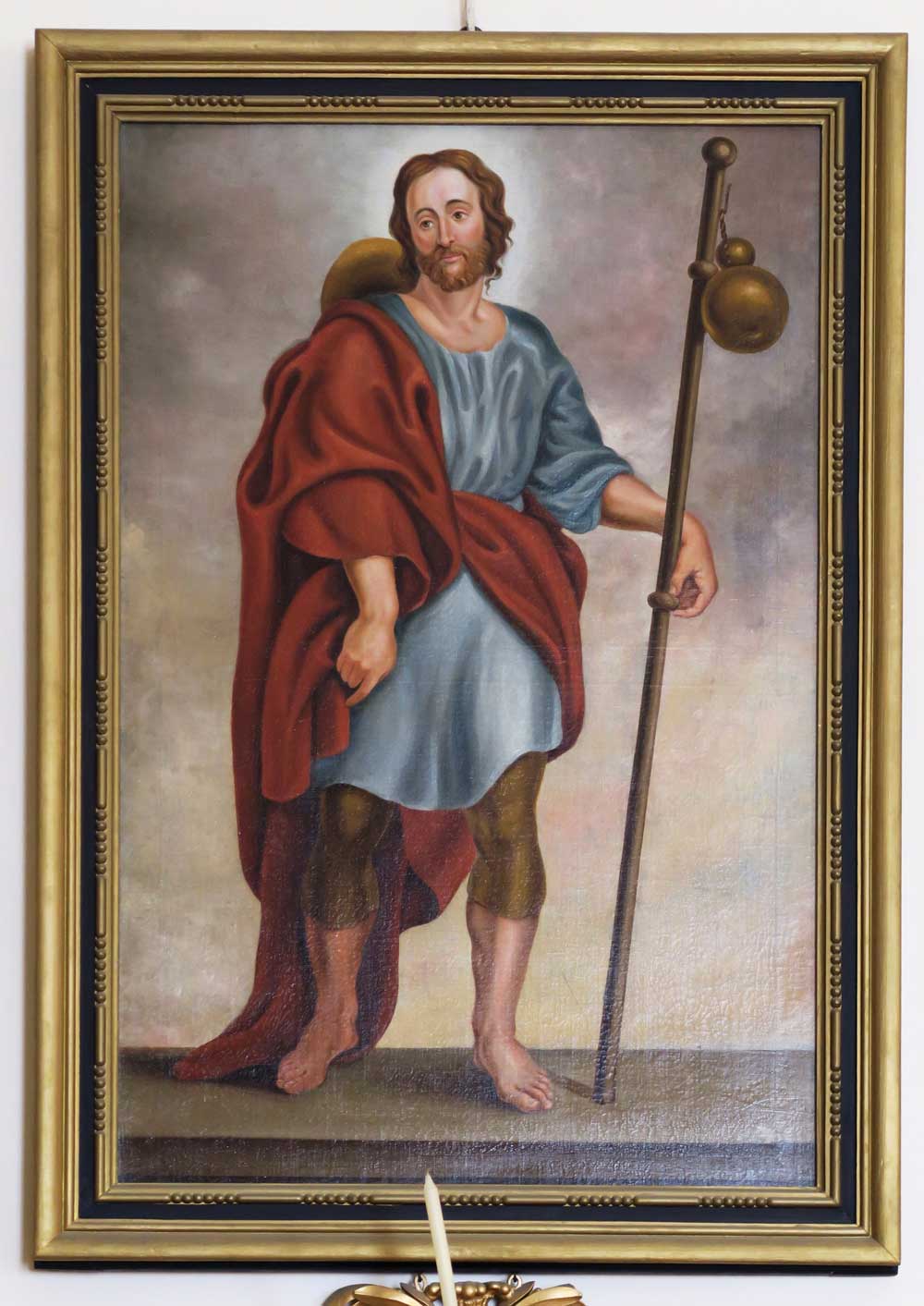
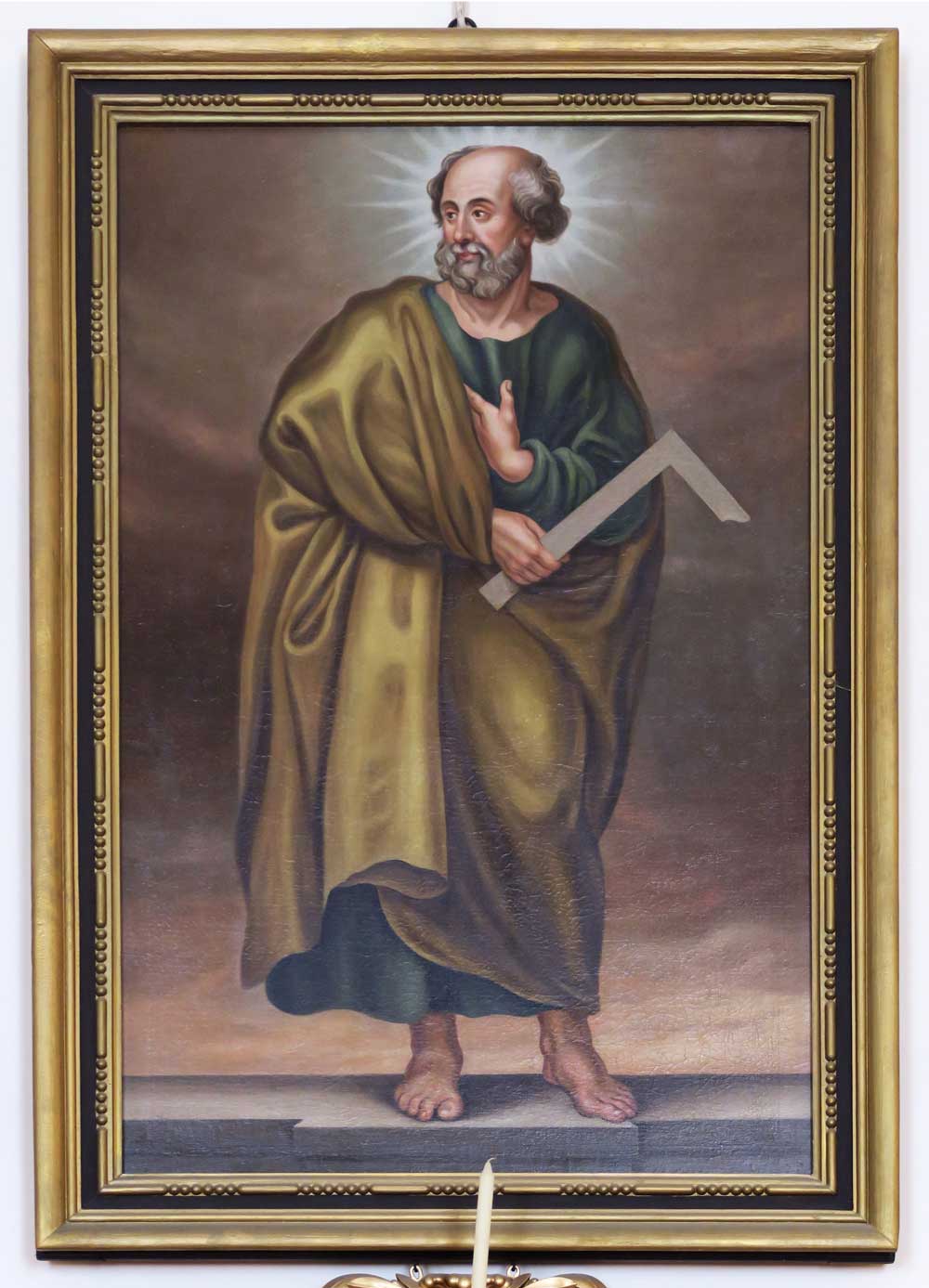
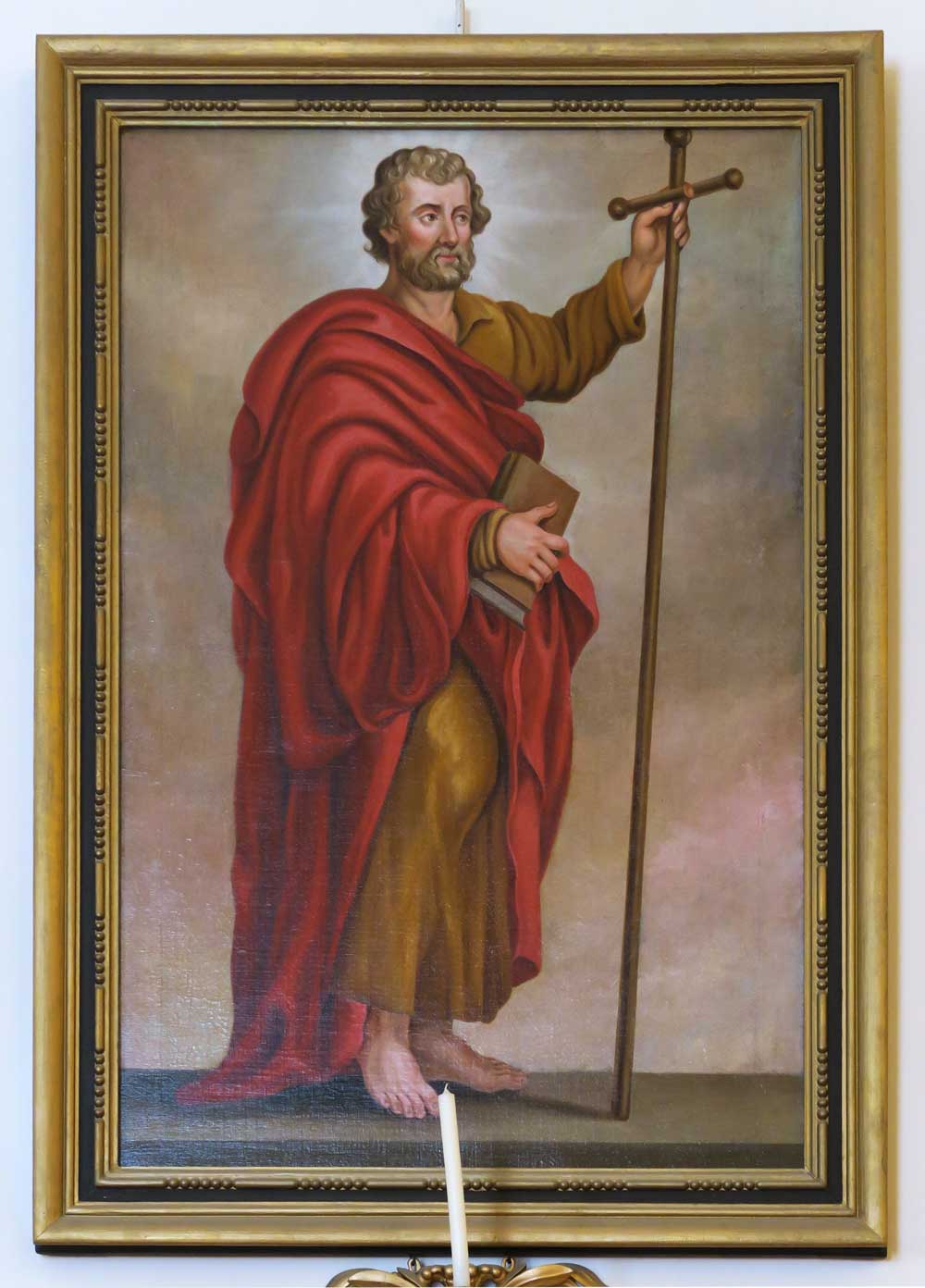
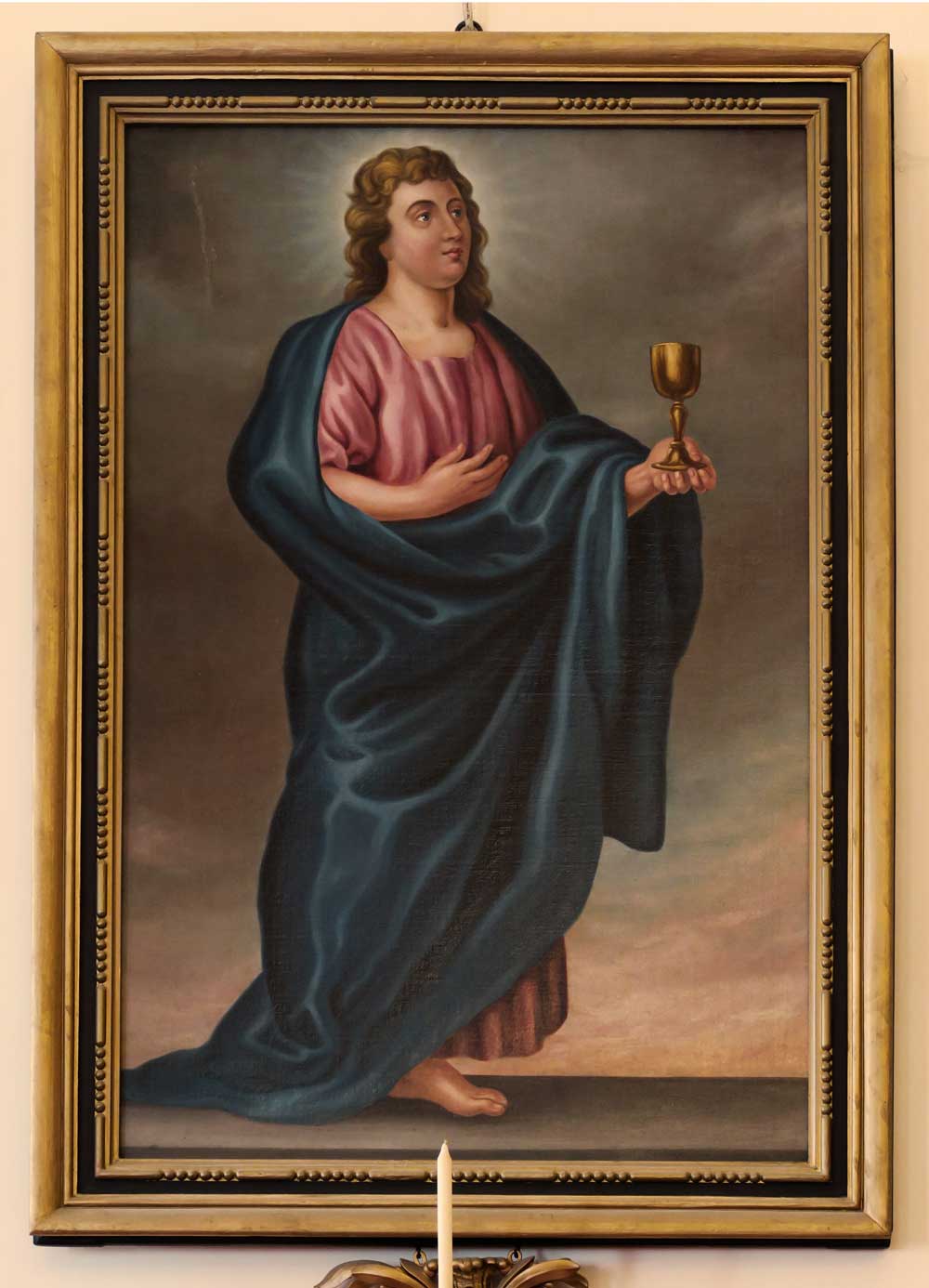
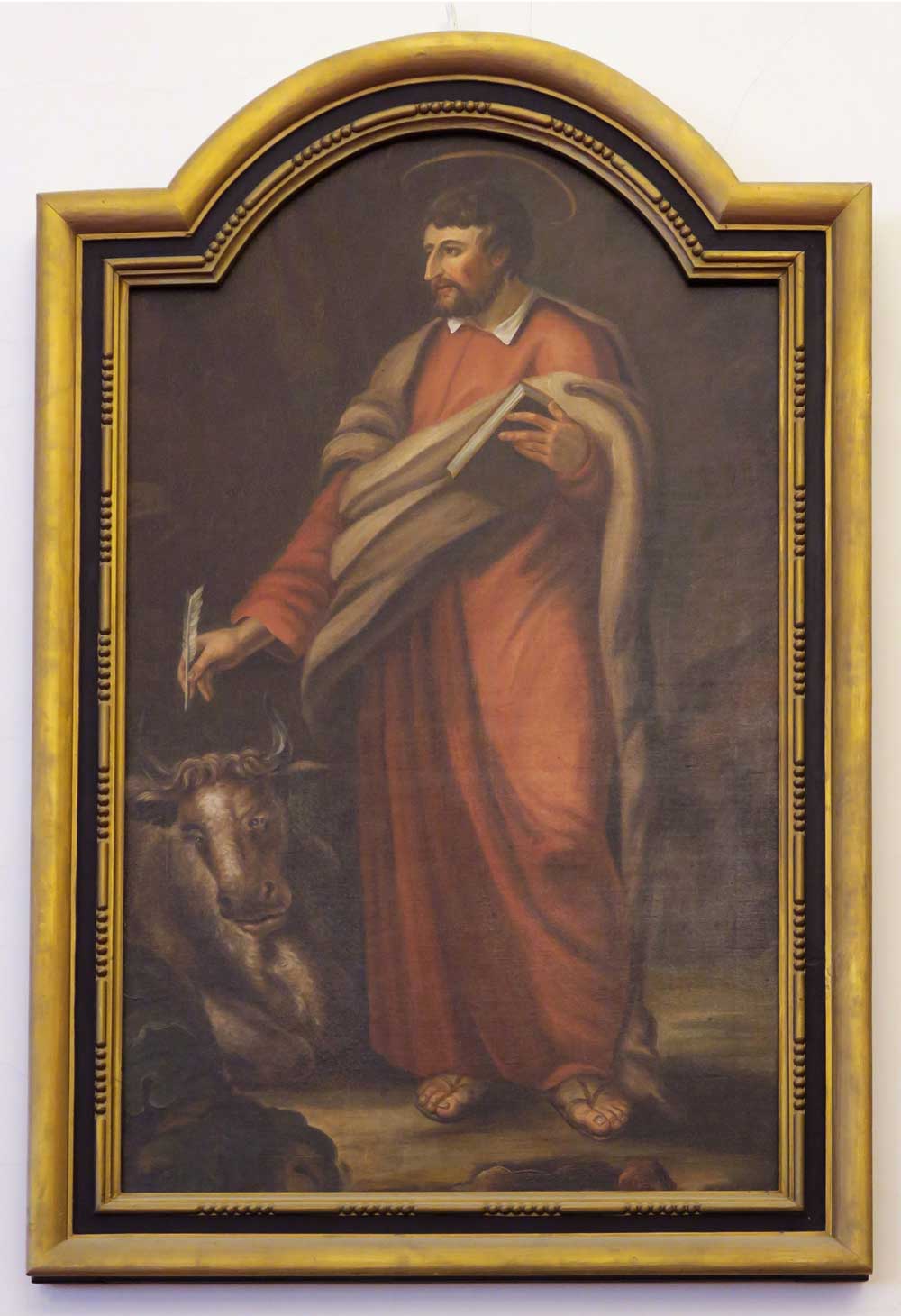
A set of 13 paintings representing the 12 apostles and one evangelist (Saint Luke), painted by Louis Dulongpré (1759–1843) and donated to the Augustinian community by the family of Jacques Dénéchaud (1728–1810) in 1805 to adorn the walls of the newly reconstructed church. Louis Dulongpré drew inspiration from the series of engravings SS. Apostolorum Icones (1646–1650) executed by Cornelis Galle the Elder (1576–1650) and Pieter Clouwet (1629–1670), which themselves were inspired by compositions by Peter Paul Rubens (1577–1640). It should be noted that the painting representing the evangelist Saint Mark, part of the same collection, is not displayed.
Source: Cultural Heritage Directory of Quebec, Ministry of Culture and Communications of Quebec.
Each of the apostles is depicted with a symbol associated with them. Below is an explanation for each.
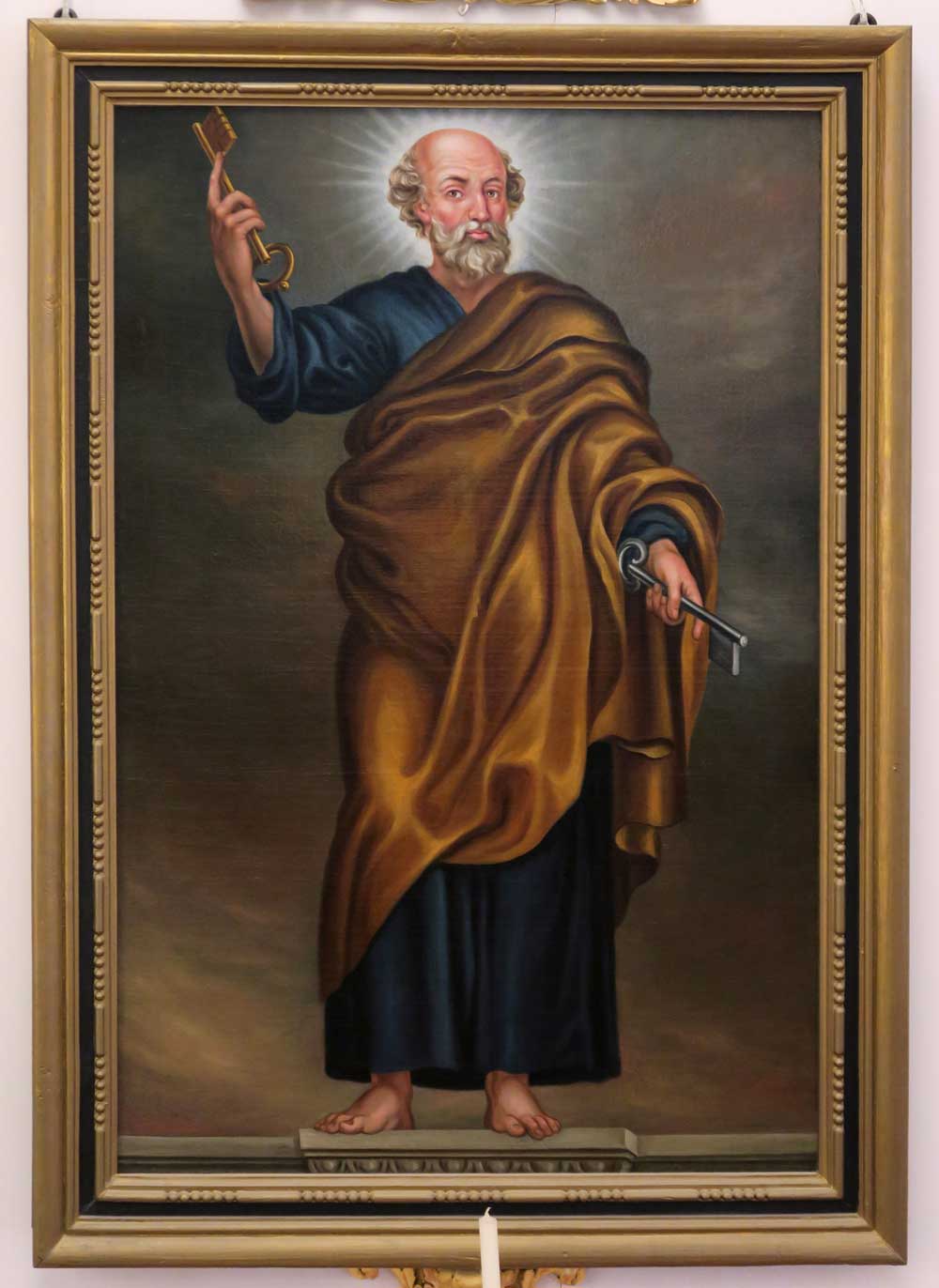
1
Saint Peter
keys
Saint Peter is recognized because he holds a gold key and a silver key. Saint Peter is depicted with keys because, in the Gospel according to Matthew (16:18-19), Jesus declares: "(...) I tell you that you are Peter, and on this rock I will build my Church. I will give you the keys of the Kingdom of Heaven. Whatever you bind on earth will be bound in heaven, and whatever you loose on earth will be loosed in heaven." The gold and silver keys symbolize the heavenly and the earthly, respectively.
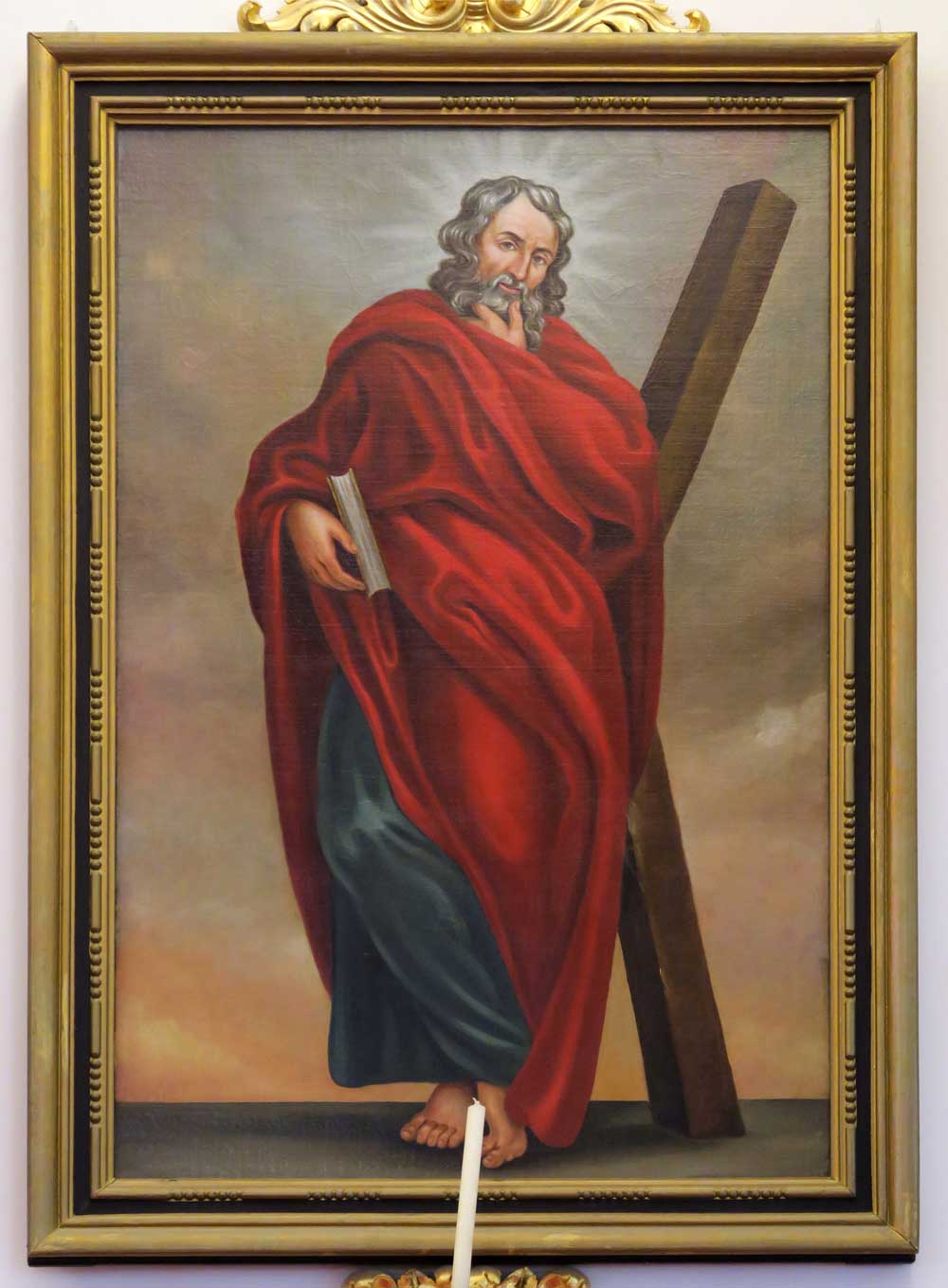
2
Saint Andrew
X-shaped Cross
Saint Andrew is identified here by the cross behind him. The apostle is said to have been crucified under Emperor Nero in Patras in the year 60, on a cross with equal arms in the shape of an "X."
3
Saint Bartholomew (Nathaniel)
Knife
The apostle can be recognized by the knife he holds in his left hand. This object refers to the martyrdom of Saint Bartholomew, who was flayed alive in Armenia.
4
Saint Matthias
Axe
The painting depicts Saint Matthias, recognizable by the axe he holds in his hands, as he was executed by beheading. He is the 13th apostle, chosen to replace Judas.
5
Saint Simon
Saw
Saint Simon is recognized by the long saw shown behind him in the painting. He is depicted with the saw because, following his death, he was said to have been cut in two.
6
Saint Matthew
Halberd
Although Saint Matthew is generally depicted writing the Gospels or as a winged man, he is shown here with the instrument of his martyrdom, a halberd (a type of axe).
7
Saint Thomas
Spear
Saint Thomas is depicted holding a spear to symbolize his martyrdom. While traveling in India, the apostle refused to venerate a pagan idol, thereby insulting the city's high priest, who killed him by piercing him with a spear.
8
Saint James the Lesser
Club
Saint James the Lesser is identifiable by the club in front of him. He is depicted with a club because it symbolizes the manner of his death. He was reportedly thrown from the top of the temple in Jerusalem. Surviving the fall, he was then struck on the head with a fuller’s rod. Over time, iconographic tradition replaced the rod with a club.
9
Saint James the Greater
Pilgrim's Staff
Saint James the Greater can be identified by the pilgrim's staff he holds. The apostle is depicted with the attributes of a pilgrim to reference the pilgrimage of Compostela, established in his honor.
10
Saint Jude
Square
The apostle is depicted here with a square. There is little information about the origin of this iconography, other than the fact that Saint Jude's square represents his role as the architect of the house of God.
11
Saint Philip
Cross
Saint Philip is identified by the cross he carries, which is the instrument of his martyrdom.
12
Saint John
Chalice
Saint John can be recognized as the youngest apostle-evangelist, holding a chalice in his hand. He is depicted with a chalice to reference his trial by the high priest of the temple of Diana. The priest told him, "If you want me to believe in your God, I will give you poison to drink, and if it harms you not, your God will be the true God." John blessed the chalice before drinking the poison and survived the ordeal.
13
Saint Luke, Evangelist
Bull
Saint Luke can be recognized by the bull at his feet. The bull is used as a symbol for this apostle because it is associated with sacrifice, and the Gospel of Luke begins with the mention of Zechariah, the father of John the Baptist, a priest of the Jerusalem temple.
Self-guided tour of the historic church
Download the PDF at the following link:
https://centrecatherine.ca/wp-content/uploads/2024/12/visite-autonome-eglise.pdf
Virtual Tour
You can now visit the Centre Catherine-de-Saint-Augustin from the comfort of your home with a virtual tour.
You can also explore the Church of the Augustines of the Hôtel-Dieu de Québec online via the following link: